First, and before I forget to tell you - give yourself the greatest gift of science and try to attend at least one Gamma Delta T cell conference before you give up on science. The amount of joy this cell type and the interactions with people working on these cells/ this field has brought me -is simply indescribable.
The biennial International Gamma Delta (γδ) T Cell Conference brings together scientists from around the world to share cutting-edge discoveries about γδ T cells—a unique and versatile group of immune cells involved in infection control, cancer surveillance, and inflammation regulation. This meeting fosters collaboration and innovation, advancing both fundamental knowledge and translational strategies to improve human health.
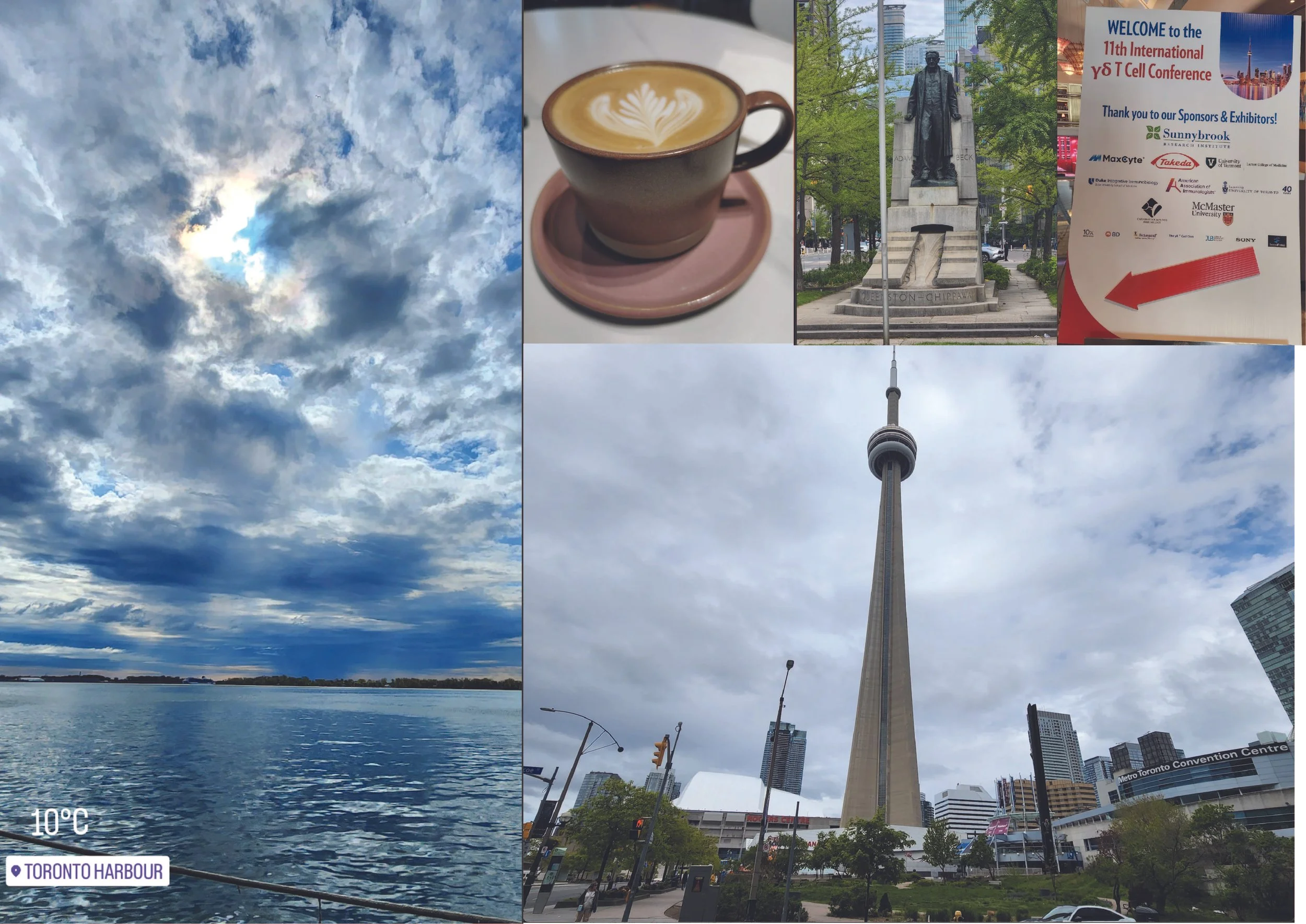
Held every two years, the conference traditionally alternates between Europe and the Americas, with occasional meetings in Asia. The most recent event—the 11th International γδ T Cell Conference—took place in Toronto from May 20–23, 2025, drawing approximately 350 attendees from academia and industry. While most participants came from the U.S., Canada, and Germany, there was strong representation from across the U.K., Europe, Asia, and the Pacific. Organized by Professor JC Zuniga-Pflucker, with support from Drs. Michele Anderson, Maria Ciofani, and a dedicated local organizing team (myself included), the Toronto meeting was one of the most memorable to date.
This marked my fourth time attending a γδ T cell conference (three in-person, one virtual), with the 2014 meeting in Chicago being my first. I vividly remember being surrounded by 300 people who worked on these fascinating cells—who were genuinely excited about posters and eager to talk science with trainees. I’ll never forget nervously approaching Karine Serre and Julie Ribot (then in Bruno’s lab) to rave about their work, and how patient and generous they were in response. Of all the meetings so far, the 2016 London conference had the deepest impact on me: I gave a short talk in the first session after Adrian’s opening seminar and, although my talk was only okay, the experience made me feel seen and connected to the community. I made many new science friends there—connections I still cherish today.
But Toronto? Toronto wins by a landslide. For so many reasons. First, I had massive FOMO from missing the Portugal 2023 meeting—something I may never fully recover from—so I arrived in Toronto with two years’ worth of bottled-up enthusiasm. Second, this was my first time contributing as a local organizer—helping with abstract reviews, judging assignments, and more—which gave me the chance to "sit at the grown-up table" and feel a deeper sense of belonging in the community.
Being at the Toronto meeting felt like coming home to family for a summer break—reuniting with the scientists I looked up to as a grad student and seeing their excitement for the next generation. There’s something deeply joyful about watching scientists in their element, rooting for their trainees, and celebrating the success of colleagues—even friendly competitors. It’s one of the most beautiful aspects of academia: learning how to be fiercely proud of others’ growth.
One thing we learned about the γδ T cell field in Toronto is that… there is no unifying theory. But perhaps the unifying force is that we’re all here, giving it everything we’ve got, trying to make a difference. Professor Erin Adams delivered a remarkable keynote on ligand recognition, revealing that around 20% of γδ T cells may rely on MHC presentation—a major conceptual leap. While, Professor Bruno Silva-Santos gave a masterful summary of 30 years of research, spanning development, infection, cancer, and therapy, and he showed just how much frontier remains to be explored. On the final day, as I looked around the packed lecture hall, I sensed a collective, quiet determination—everyone holding on tightly to a feeling of hope, knowing that after we all dispersed, we’d have to find our own ways to motivate ourselves. To nurture that inner science child, the one who still thrills at discovering something new. again and AGAIN.
My most favorite thing about the meeting was to see friends. Old friends, new friends, and those who will likely become my life long friends. I learned that everyone is slightly panicked.. slightly hopeful and somewhat unclear about what the future (next 2 years until next meeting) will look like. Whether it was a graduate student or a postdoc fellow beginning their journey.. or those who were finishing up. Whether it was someone who had transitioned into industry or had been there for far too long. This feeling of uncertainty was global and constant. It is comforting, in it’s own way, to think that if enough intellectuals choose to feel panicked about something - they will figure out a way to get us out of this mess as well.
So, I returned from Toronto feeling inspired, energized and jolted with hope. Not just for my future ..but for the future of science as a whole. Even if the paths look flinty at times. Even if those paths repeatedly lead us to a bar with Estonian folk musicians who dazzle us with (lengthy) songs. Even if we never can find a place to go dancing or karaoke in the rainy Toronto. Even if it means that we have to hunt 10 different coffee places to find the best cup of cap (Daily dose was great, btw). And, especially if it means that we have to watch our European friends suffer through “not so great” North American beers.. night after night… just so they can hang out with us to share life, science and everything that tethers them together. Even still.. we forge ahead!
So, until Poland 2027.. we will dance with the ghosts of these incredible memories from Toronto. Perhaps with a bruised soul at times.. maybe even w/ blistered feet at other times. But, dance, we will!