..the last harvest of 2022

It is almost the end of 2022, and I am officially done with all the bench work for the year. It has been an excruciatingly (well, seemingly) long year filled with gut-wrenching trials and trepidations in science. And as I look back to remember what I have accomplished, there have been many highs and some lows. The one thing that has been consistent throughout the year, is not taking science for granted. I have always leaned very heavily on science to find comfort and excitement, not always joy :). Looking back, I have endured a lot more physical and mental pain this year than any other. Here’s a summary of what it’s been like.

first, the highs..

memory, and protecting

Everything about memory (both immune and otherwise) is fascinating for me. The complexity with which it is procured, nurtured or coerced, enlisted and arsenalized (yep, I just made that word up) over and over ..throughout our life is truly unbelievable. I think about this concept constantly, seamlessly, tirelessly and joyously. And, I don’t just mean ..when thinking about work.. especially, off work..when I am talking to my loved ones, friends, colleagues, while watching tv, etc. So, that’s my thing. Memory. And, this year, I’ve had the privilege to think more freely about it.. than ever before. I was able to systematically gather (experimental) evidence on something I feel absolutely and intoxicatedly passionate about.. immune memory. This work has been a long time coming and will soon be available for the world to see.

Working w/ my team.

I’ve had the unbelievable honor and pleasure to work on some of the most complex aspects of science with my colleagues and mentor this year. Esp formative experience, was working on grants with my mentor. But, the process of articulating hypotheses and caveats to them, as rewarding and exciting, has instilled the realization that.. as scientists, we stand on some heavy shoulders (predecessors of discoveries) and no creative process occurs in vacuum, that thinking and writing are muscles that we develop all through our life and need to be exercised continuously.

collaborations

I part-took in a fantastic long-term highly collaborative project led by some incredible minds at NYU, Rutgers, Princeton and NIH..and it has been a formative experience for me as an immunologist. This has been exciting and grueling all the same. But, it has also made me a much better scientist and prepared me to think broadly about translational work, moving forward.

the obvious rewards

I’ve been incredibly lucky to have received a few significant research awards (ongoing F32, followed by Vilcek) that have felt like that protein bar and a glass of water..at the end of a 10mile run. There are too many reasons why this was no surprise, but many of how it just as well couldn’t have.

the γδ T cell club webinar series

I have no idea how we pulled it off, but we were able to materialize a 10-y long fantasy of finding a place to hang out with the greatest immunology minds across the globe, that specialize in the research of γδ T cells. This has been one of the most rewarding experiences of my career.

The lows..

disbelief can no longer be suspended

There are so many incredible things about science and academia. The open-ness, the permission to be wrong (rather rewarding the failures), the flexibility of being meticulous and haphazard in the same vein.. the blurring of hierarchy to work on something bigger. But, then there are the problems. The inability to adequately reward the intellectual and physical work in a monetary way. The fact that it takes so long to formalize a simple biological query into a testable hypothesis, nurture it with evidence that contextualizes the very fabric of that hypothesis and the uphill battle of getting the world to see it published. And, we’ve lost sight of the fact that.. ultimately, the bigger reason is for the world to learn from it and apply it to their own niches and continue the cycle forward.

so that’s really it for lows.. the cumbersome aspects of being a postdoc and the fact that this shall continue into the future of a faculty position, not so cheery.

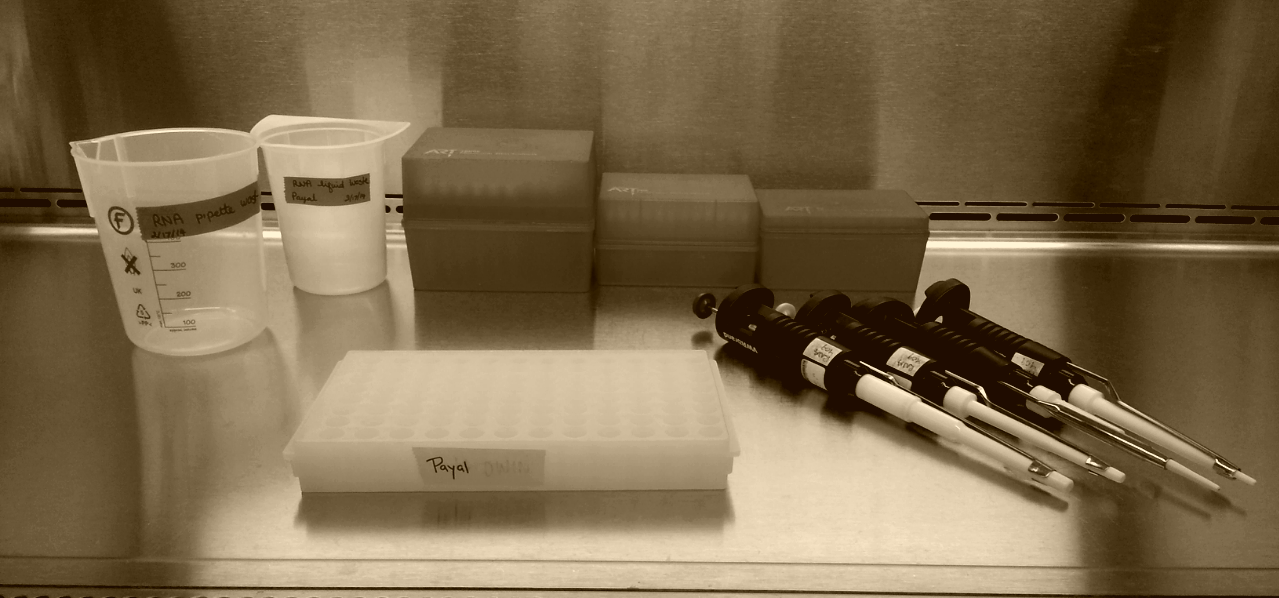
Each year, this week, I kick myself for having set up an experiment that requires me to do serious bench work when I am losing steam and in dire need of a reset before the new year. I know this, because while looking through my phone .. I noticed that I have pictures of a semi-huge harvest (DM me if you do not know what this means) obvious from pictures of pathology, calculations, etc of this week, each year. It seems that I have always had experiment between Christmas and New years.. at least as far back as last 10 years, and likely even before.

And, as I wrap up the remnants of my last harvest of the year, I am filled with joy and exhaustion from the incredible year I’ve had and all the amazing things that will follow in 2023. All the incredible connections I’ve made ..both over Twitter/LinkedIN and IRL. All the wonderful conversations I’ve had about the fundamental/paradigms of immunology and so on and so forth. So, really, it isn’t “the last harvest”, but it is one more harvest, to instill the infantile joy of being an immunologist and having the privilege to challenge the paradigms and be granted failures and rise, over and over again.

/end of rant.

Covid19, antibody neutralization and the road ahead..

July 15, 2021

I recently wrote a preview for a thought-provoking study by Alexandria Tauzin et al. (Cell Host Microbe, July 2021) regarding the efficacy and associated immune responses following a single dose of BNT162b2 mRNA vaccine (by Pfizer). You can read my preview here, where I discuss some important aspects of immune response discussed in the original paper by Tauzin et al explores few interesting concepts in this study and provides moderate resolution on some burning questions.

There’s been a long-standing debate and confusion about the generation of neutralizing antibodies against SarsCov2 (N and Spike proteins), following single or double doses of mRNA vaccines. Since, I am a scientist and it’s my day job to chop up big questions into smaller pieces.. here are the main questions:

  1. When will the neutralizing antibodies be generated following vaccination with 2 doses of mRNA vaccine? How much will the antibody titer be?

  2. How can these be detected? What will be the quality of these antibodies?

  3. Will absence or weak antibody titer correlate with weaker protection?

  4. Will the amount of neutralizing antibodies differ between individuals with a history of natural infection?

  5. Will the individuals with prior natural infection require two doses?

  6. How will previously infected individuals respond with regards to their humoral and cellular responses?

  7. Will the cellular responses fill the slack of weak neutralizing antibodies?

  8. Can we predict strong correlations between Th1 and humoral responses?

It has been over 18 months, since we were made aware that a highly transmissible strain of respiratory virus had been going around, and that it has become global. By March 2020, we’d already realized that US was not safe and lock-downs were beginning to shape up. By April, we were starting to lose a disturbing number of individuals daily and it felt like we were in a war. We realized, this was deadlier than anything we had seen and we knew little about how to protect ourselves. By December 2020, however, we had vaccination available and clinical data showed protection. Science has come through and we have found unprecedented results in a historically short timeline. So, what’s next? Here’s what we still do not know:

  • How long will the protection last from full vaccination regime?

  • How many doses will be required to vaccinate everyone (in the world)? How much time will it take, setting aside the money issue?

Tauzin et al shows that a single dose of mRNA vaccine shows quantifiable protection (humoral and cellular) in those individuals that were previously infected. If that is true, that changes things. We would need less # of vaccine doses world-wide, especially if 12.. 18.. 24 months down the road, we need a booster. So, this is pretty significant. As an immunologist with deep interest in host-pathogen interactions, it seems like there are way too many moving parts to parse through. Focusing from the viewpoint of pathology, it is elusive (still) what contributes towards long-covid. We haven’t a concrete clue in how to prescribe and diagnose for long covid in real time, let alone… retrospectively. I want to do a follow up and connect these studies to more basic immunology as we do in the Khanna lab, to keep this stream of consciousness flowing.

Let’s keep this conversation going, so please comment/discuss your ideas.

Screen Shot 2021-07-15 at 12.18.17 AM.png

Inspired and ready

This year, I co-organized my very first symposium, Inspire Science Symposium 2020.
So, I wanted to write about it and jot down things that I learned, worked and could use work in future. It’ll take me a few posts to really log the nitty-gritties, so bear w/ me.

Part-1.
What is Inspire Science Symposium?

The Inspire series started years ago with a bunch of hopeful trainees that got together and created a space to celebrate (their) science, and the baggage it came with. In part, to find individual journeys after graduate/postdoc training as well as to find what tools lay in individual arsenals in order to find those journeys. What’s really unique about this symposium, is that it tackles the need for skills required beyond just science. Skills such as communicating the science, passing it on and most importantly, making it applicable to the society. And so, since its inception over a decade ago at UCSF/Berkeley, The InspireSci Symposium Series aims to nurture scientists and expand their skills by offering a variety of topics such as science outreach, communication, networking, etc.

Sponsored by the Institute for Systems Genetics at NYU School of Medicine, 2019 edition of InspireSci broadly dealt with the topic of science outreach. But, this year, things were different. Unlike last year, we couldn’t have more than a few people in a seminar room… let alone a crowd of 100+. So, the symposium had to be virtual, and it had to set itself apart from any other online event. So, it required a brilliant idea, lot of organization, willing invited speakers and the right time.

First things first: how’d I get roped into this?
Two words, Ada Weinstock.

Ada is a K99 postdoc fellow at NYUSOM. She’s a friend, (an unofficial) mentor and someone I deeply admire for her science, her tenacity …among many other things. My first interaction w/ Ada was back in 2018, in a group meeting. I was so taken by her brain, that I actually went up to her after the meeting and asked, “Who are you?” She shot back, a little louder, the same and we’ve become friends since.

Ada sent me an email in early July about joining the InspireSci team w/ very little insight other than, “..I think you’ll be perfect at this!” July was a tricky time to take on more, considering we had just been back in labs for a few weeks and things were starting to look up for experiments. Albeit hesitantly, I said yes because I trust Ada. With the general theme of Staying inspired in uninspiring times, the InspireSci team assembled and began coordinating schedules to have a first (zoom) meeting.

Organizing a symposium

What does it take to organize a virtual (or any) symposium? It has to start with a really good idea. In our first organizational meeting, we focused on a theme. Under the broader theme of Staying inspired in uninspiring times, we started to dig in for something narrower but not “only” about the pandemic. Reason being, so much of being an academic is this pendulum of swinging between the highs and lows. Highs can be small and large successes that are few and far. On the other hand, lows are constant and come frequently and in all sizes. Luckily the half life of highs, outlast the many annoying lows. Or, so I’d like to tell myself. Therefore, staying inspired can’t only be about the pandemic and it’s fore-and-aftermath. It has to be about life of a scientist, in general. Because, that.. that is timeless. With that in mind, we came to this theme of an intersection. An intersection of where science, culture and politics meet. I’ll explore on that a lot more in the next post, but for now, the theme quickly became about a triangle w/ three corners …Science, Culture and Politics. And, so it began.

Divide, to conquer.
Our next task was to designate tasks to individuals and make smaller teams to remain organized and focused. I volunteered to take on Media because I find it easy to tweet about science (having done it for 12y) and have a substantial amount of science-network in the NYC area. But, ofcourse, I was also interested in using that network to help find speakers. I got two awesome partners to work alongside for the Media - Bianca and Mericien. Two fantastic humans with very specific skills and darn good taste. So, we started strategizing on when, what and how to get the word out in the subsequent weeks. We had to get the website up, twitter/Insta/LinkedIN set up and most importantly, a nice Logo revamp.

The Logo
For this, I reached out to a dear friend, Elisa Lau (aka Pinkimoon). Elisa is a brilliant illustrator and creative soul with many unbelievable projects stuffed in her portfolio. But, since we didn’t have any money, she agreed to help me out as a personal favor and listen to the theme and came up with some mock ups for the Inspire Symposium logos. I told her I wanted a human sitting at the precipice of thought and innovation pondering how to coerce the impacts of knowledge (Science) and policy (Politics) into the community at large (Society). And, boy, did she deliver! See the logo below!

Getting started
The meat of getting things organized requires the benefit of experience. We had a bunch of veterans from previous meeting, so that helped. Along with Ada, we had Sud (Sudarshan Pinglay). My first impression of Sud was that he was fun, mild mannered with a touch of refreshing team spirit, matured beyond his age. With some great hands on technical side (Nakisha, Deb and Meghan) and the fantastic graduate student duo (Johanna and Julie on the activity team), we were pretty set on what / when/ how to forge ahead. Ofcourse, all of this was meaningless, if we didn’t sort out Speakers.

Finding speakers who fit our theme creeped up at the top of our priority by the end of July. Since we had unanimously approved the theme of Science, Culture & Politics, we already had pretty good ideas on what kinds of people we needed to fill spots. We got pretty lucky and were excited about how warm, encouraging and informative these interactions were. In the next post, I will describe why and how we chose the speakers we did, and how it all turned out. Stay tuned.

InspireScienceLOGO_2020