γδ TCR--> αβTCR: A tale of altered commitments.

Part-1 : The set up and the preliminary questions

Continuing the conversation about T cells with peculiar TCRs, I want to talk about CD4+ γδ Tcells. Specifically, how they are developed and how they change the committment and transform into αβ TCRs.

T cells never fail to intrigue me with their ability to differentiate and memorize the numerous antigenic signatures from a variety of pathogens and provide robust recall responses from second exposure (and onward). αβ T cells do a majority of the heavy lifting by compartmentalizing into functional phenotypic subsets such as naive, effecetor and memory T cells. Evaluation of plasticity or interchangeability of one functional phenotype of T cell to another is an ongoing area of research.

Hendrik Ziegler and colleagues recently published a scandalous paradigm shifting study in Frontiers of Immunology (Dec 2014) about a subset of T cells that co-expresses a CD4 co-receptor and a Vγ1+ γδ TCR. Here's a link to the Original study.

Relevant background

How T cells get those γ and δ chains or α and β chains, is a well characterized pathway. Below is a figure that highlights the stages of T cell development and the steps of maturation. There is a lot of detail that goes with the figure below, but this generalized version is much easier to look at.

2015-02-19 00_31_36-Spring2015_PY.pptx - Microsoft PowerPoint.png
2015-02-19 00_25_45-Presentation1 - Microsoft PowerPoint.png

To become a fully functional αβ TCR, genes for functionally rearranged β-chain are expressed leading upto the forking of T cell committment into CD4+ or CD8+. The thing to remember here is that the δ locus is embeded into the α locus and is deleted to form a fully functional αβ TCR to be formed.


In addition to the depletion of functional thymus through our lifetime (as shown in the bargraph above), "The thymic involution begins as early as 1 year after birth, resulting in an exponentially decreasing output of naïve T cells, which is almost completely extinguished post adolescence. The total size of the T-cell pool nevertheless remains relatively constant throughout life, which suggests that the T-cell pool must be replenished in some other way." (From Ziegler et al.) How does this happen has been studied extensively through past few decades, which instigates whether the plasticity among the different lineages such as γδ vs. αβ may also contribute in replenishment of the naïve T cells. What is needed, however, is a pool of cells with stem cell markers that can differentiate into lineages starting from the pre-TCR phenotype.

Ziegler et al shows a mechanism for CD4 expressing γδ TCRs that carry markers for earliest hematopoietic progenitor cells and carry full-length transcripts of in-frame δ, γ, and β TCR gene rearrangements in addition to genes and enzymes that are characteristic of progenitor populations (such as DN1 and DN2). The central hypothesis of this study is as follows:

Under inflammatory environment, CD4+ γδ T cells can form fully functional αβ TCR+ T cells.

How this happens will be discussed in the subsequent parts of this blog.
δ/αβ T cells and Ag recognition

Hi there.

My first blog entry and I've decided to start by talking about a recent paper I read and enjoyed, written by Pellicci et al. and published in JEM (2014). Here is a link to the original paper, The molecular bases of δ/αβ T-cell mediated Antigen recognition. I've always been a fan of Dale Godfrey papers, and the last few ones have definitely been top shelf. So, it makes sense to start with this paper.

Brief background:

Traditionally, αβ T cell receptors (TCRs) have been known to recognize antigens presented by Class I (in case of CD8) or Class II (CD4) MHC peptides that are expressed on antigen (Ag) presenting cells. In the past 10 years, evidence has been shown by many that suggests that certain T cell lineages are able to express lipid-based Ags from the CD1 family. Using Crystallography, Pellicci et al shows that the peculiar T cell subset expressing δ/αβ TCR is able to recognize CD1d-restricted-α-GalCer in a manner that is distinct from NKT cells. This is relevant because CD1d-α-GalCer is a glycolipid extracted and isolated from the marine sponge, and a prototypic ligand for activating type I NKT cells. For more information on NKT cells and CD1d, Godfrey papers are a great resource.

Central Hypothesis:

δ/αβ T cells are a group of cells "that bind Ag by way of both Vδ and Vβ genes, thus reflecting a greater level of diversity and functional potential withing T cell lineage."

Main questions addressed by the study:

  • What is the frequency of δ/αβ T cells?
  • How do they see an Antigen?
  • What kind of Ag do they recognize?
  • Can we coerce this interaction?
  • How is the Ag recognition by δ/αβ TCR distinct from a conventional αβ TCR or a γδ TCR or Type I NKT cells?

The first part of the paper deals with characterizing the δ/αβ T cells using flow cytometry. Authors show that δ/αβ T cells are less frequent in the total pool from normal human PBMCs and highly variable from one donor to another. They have a hybrid TCR where a Vδ (δ1) chain is fused to Jα and a Cα parts of the α-chain, and pairs better with a β-chain (albeit, not expressing Vβ11 -characteristic of Type I NKT cells). This pairing is better than that of a γ-chain, which is expected for a γδ TCR. This is important, because the cytokine expression of IL-2, 4, 13, 17A, IFNγ, GM-CSF as well as TNF- is very similar to that of αβ T cells.

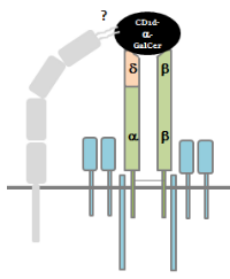
Second part of the paper deals extensively about the interaction of the δ/αβ TCR to CD1d-restricted-α-GalCer Antigen. Authors thoroughly examine the similarities and differences of this interaction by using specific clones for NKT cells, αβ T cells and γδ TCR. The intricacies of crystallography reveal that CD1d-α-GalCer interaction to the δ/αβ TCR is highly variable from clone to clone and within donors. However, in an example shown by the 9B4 clone (specific mAb for the δ/αβ TCR), authors clearly show that there is a 2-point interaction where both Vδ1 chain and the β-chain are involved, contributing to a better affinity and longer interaction time. To summarize, this small subset of T cells bearing a hybrid δ/αβ TCR is able to recognize a CD1d-α-GalCer antigen with high affinity.

Here are my reasons why this study is so fantastic and significant for the field:

  1. For non-conventional T cells, such as those bearing a γδ TCR, there are very few known ligands and therefore, fewer ways of selective expansion. Having a system described by Pellici et al materializes ways in which γδ T cells can be selectively expanded and analyzed for requirements for their pairing γ-chains. This is especially important in studies which look at gene expression tied to specific TCR chains.

  2. Beyond the expression of cytokines, Pellicci et al does not add much to the functional side of these T cells, which makes sense as the scope of the paper narrowly evaluates the requirements for ligand interaction. From the flow cytometry data, it seems that most of the δ/αβ Tcells in this study seem to coexpress DN or CD8+ T cells.

  3. Generally, speaking, the most intriguing question is the function of δ/αβ T cells development of central memory and effector functions of T cells. Ag recognition and expansion is incomplete without understanding the subsequent transcriptional consequences. In other words, what other Ags can the dual δ and β - bound recognition system recognize?

  4. Here's my most bold claim of all: is there a possible link to the most important riddle of T cell lineages.. a link between the lineage committment between the αβ and the γδ T cells? Yes, the α locus carries δ within and subsequently deletes δ upon formation of a fully functional α chain for the αβ TCR. Maybe these cells are generated and conserved with the hybrid receptor for a specific function, one which we do not know of ...not as of now!

Stay tuned for the next review that will pick up where we end.

Following is my graphical representation of the δ/αβ TCR based on the findings in this paper and an added modification of existence of an unknown co-receptor molecule expressed on these T cells.